
 Nederlands
 Deutsch
 Français
Throughout the month, we continued advancing the Inheriti® ecosystem with a strong focus on the active testing and refinement of Inheriti® Business. Following the important milestone reached in August, our team and close partners have been putting the platform through real-world organizational workflows, allowing us to validate its architecture, strengthen key governance processes, and further refine the overall user experience. At the same time, development across Inheriti® Elements continued to expand the flexibility and integration capabilities available to partners. These efforts represent another important step toward delivering a secure, scalable, and enterprise-ready digital continuity ecosystem built for real operational environments.
From Active Testing to Real-World Validation
Following the transition of Inheriti® Business into active testing last month, our focus has shifted from validating individual platform capabilities to testing how the complete system performs across real organizational workflows. Our team and close partners are now actively working with the platform, allowing us to observe how governance, access control, approvals, organizational structures, and recovery processes operate together in practice.
This phase is particularly important because enterprise security cannot be validated through technology alone. A platform may perform exactly as designed from a technical perspective, but it must also reflect how organizations actually operate — with different teams, responsibilities, approval requirements, infrastructure environments, and levels of authority. Active testing allows us to evaluate these interactions and identify where workflows can be made clearer, more efficient, and better aligned with real operational requirements.

Throughout this process, we have been refining the way organizations, teams, users, roles, and protected secrets interact within Inheriti® Business. Particular attention has been placed on ensuring that responsibilities remain clearly separated while authorized users can efficiently perform the actions required by their role. Approval and governance workflows are also being tested across different scenarios to ensure that sensitive operations remain controlled, traceable, and aligned with organizational policies.
Testing is also helping us evaluate the platform from the perspective of administrators and everyday users. Enterprise security should provide strong controls without introducing unnecessary operational complexity. Feedback gathered during this phase is therefore being used not only to strengthen the underlying platform, but also to simplify workflows, improve usability, and make complex governance processes easier to understand and manage.
Each testing cycle provides another layer of validation. Findings are reviewed, improvements are implemented, and the updated workflows are tested again. This iterative process allows us to strengthen Inheriti® Business based on practical experience rather than assumptions and ensures that the platform continues to evolve around the requirements of organizations that will ultimately depend on it.

Moving from active testing toward real-world validation represents an important step in the development of Inheriti® Business. We are no longer only demonstrating how the architecture is designed to work — we are validating how it performs when applied to real organizational structures, responsibilities, and security workflows.
This is how we move closer to our objective: providing organizations with a practical governance and digital continuity layer capable of protecting critical digital assets while ensuring that access, authority, recovery, and control remain resilient over time.
But Inheriti® Business goes beyond protecting individual secrets. The distributed trust model creates a governance layer capable of connecting the different components organizations already depend on — cloud environments, HSMs, vaults, identity and access management, organizational roles, approval processes, legal procedures, and recovery workflows — into a coordinated architecture built for security and long-term resilience.
This becomes increasingly important as organizations operate across more complex digital environments. Business continuity can no longer depend solely on how well each individual system is secured. It also depends on how access, authority, recovery, and control are governed across those systems as a whole.
That is the layer Inheriti® Business was built to provide.

The future of enterprise security is not simply about adding another vault, another HSM, or another security product. It is about ensuring that every layer works together as part of a coordinated system — protecting not only critical digital assets, but also the organization’s ability to maintain access, recover, and continue operating when circumstances change.
Seeing Inheriti® Business move from development into active testing with our team and close partners is an important moment for us, and another major step toward bringing this vision into real-world organizations.
Refining Governance, Roles and Approval Workflows
As Inheriti® Business moves through active testing, one of our key areas of focus has been refining how governance operates across organizations, teams, users, and protected digital assets. Enterprise environments rarely rely on a single administrator or decision-maker, so security must reflect how authority and responsibility are distributed throughout an organization.
Inheriti® Business enables organizations to establish clearly defined roles, determine which users can perform specific actions, and introduce approval requirements for sensitive operations. During testing, we have been refining these interactions with particular attention to role-based access control, separation of responsibilities, approval workflows, and the relationship between users, teams, and protected secrets.
Approval workflows are especially important when managing critical digital assets. Certain actions should never depend on a single individual. Inheriti® Business allows organizations to introduce multi-party authorization and moderation processes, ensuring that sensitive operations can require approval from designated participants before they are executed.

At the same time, strong governance must remain practical. Our testing therefore focuses on balancing granular control with operational efficiency, allowing organizations to implement sophisticated security policies while keeping everyday workflows clear and manageable.
Every authorized action also contributes to a transparent and verifiable operational history, providing organizations with greater visibility into who initiated an action, how it was authorized, and how critical assets were managed.
Together, these capabilities create a governance environment where organizations maintain control without concentrating trust — transforming digital asset protection from isolated security controls into a coordinated organizational process.
Advancing Inheriti® Elements
Throughout the month, development of Inheriti® Elements focused on preparing individual components for more consistent integration and deployment across partner environments.
A key area of work has been improving how individual Elements communicate with each other and with external systems. We continued refining interfaces between components, standardizing integration flows, and reducing dependencies between individual modules. This allows partners to implement specific Inheriti® capabilities without requiring deployment of the complete ecosystem.
We have also been working on improving deployment consistency across different environments. This includes refining configuration processes, strengthening communication between services, and identifying areas where integration steps can be simplified or standardized. These improvements are intended to reduce the amount of custom implementation work required when introducing Inheriti® technology into an existing infrastructure.
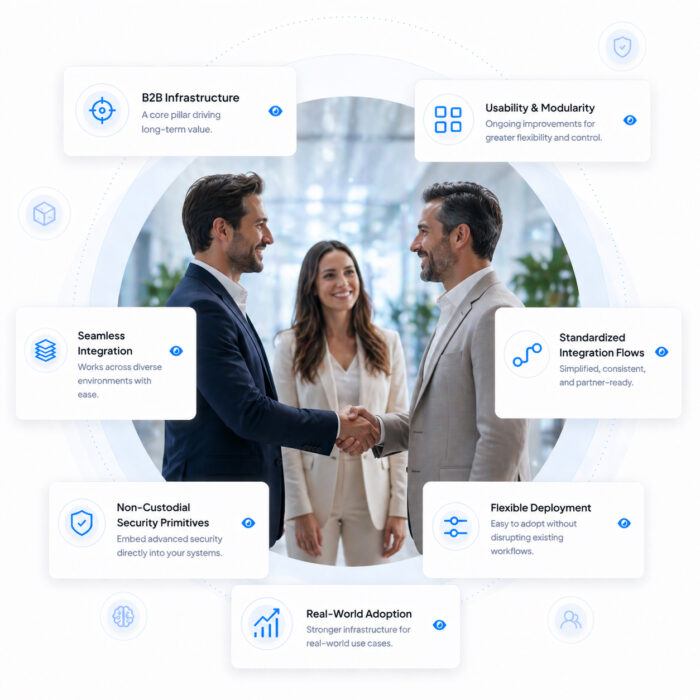
Another focus has been validating that individual Elements can operate independently while maintaining compatibility with the wider Inheriti® architecture. This is particularly important for partners that may initially require only a specific capability and later choose to introduce additional Elements as their use case develops.
The work completed during this development cycle brings Inheriti® Elements closer to a more standardized integration model, with clearer boundaries between components, more consistent interfaces, and a stronger foundation for partner implementations.
Our next development cycles will continue building on this foundation as we move individual Elements toward broader integration and real-world deployment.
Building the Foundation for Broader Enterprise Adoption
As Inheriti® Business progresses through active testing, our development focus is increasingly extending beyond individual features toward the requirements needed to support broader enterprise adoption.
Real-world organizations operate with different team structures, security policies, approval processes, infrastructure environments, and operational requirements. Supporting this diversity requires a platform that can adapt without introducing unnecessary complexity or compromising the security principles at its core.
Throughout this development cycle, we have therefore been focusing on making organizational setup, governance configuration, access management, and operational workflows more consistent and easier to manage. Feedback from our team and close partners is helping us identify where processes can be simplified, where additional controls are required, and where the platform needs greater flexibility to support different organizational structures.

We are also validating how Inheriti® Business can operate alongside existing enterprise infrastructure. Organizations should not need to redesign their security architecture to introduce digital continuity. The platform is being developed to complement existing identity systems, cloud environments, HSMs, vaults, and internal security processes while providing a governance layer that connects these components through clearly defined policies and workflows.
This work is an important part of preparing Inheriti® Business for the next stage of its development. Each improvement made during active testing strengthens the foundation required to support more organizations, more complex environments, and a broader range of enterprise use cases.
Our objective remains clear: to make advanced digital continuity and distributed governance practical to implement within real organizations, without requiring them to replace the infrastructure and security investments they already rely on.
Join the Inheriti® Business Pilot Program
The Inheriti® Business Pilot Program continues to welcome selected organizations and partners interested in testing the platform in real operational environments. Participants have the opportunity to explore how distributed governance, structured access controls, approval workflows, and digital continuity can be applied within their own organizational context, while sharing practical feedback directly with our team.
As testing progresses, this collaboration becomes increasingly valuable in helping us validate real-world requirements and refine the platform around the challenges organizations actually face. Organizations looking to reduce dependency on individual key holders, strengthen governance over critical digital assets, and establish more resilient access and recovery processes are invited to register their interest and participate in the next stage of Inheriti® Business development.
Register for the Pilot: https://inheriti.com/product/inheriti-business/#pilot
Try Inheriti® Today — Protect Your Digital Legacy for Free
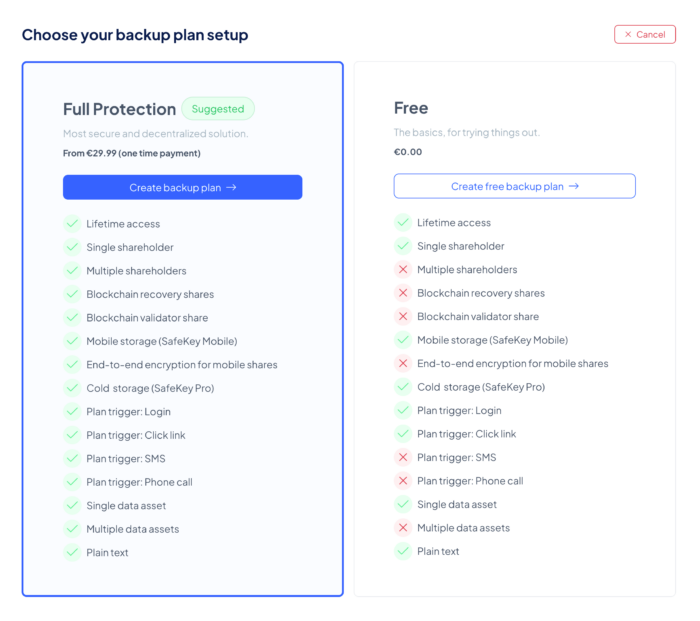
Your digital legacy deserves protection — and getting started should be simple. With Free Backup Plans in Inheriti®, anyone can take their first step into digital inheritance at no cost. A Free Plan allows you to create a basic backup, assign a single shareholder for personal use, and securely store your encrypted information using SafeKey Mobile. Whether it’s passwords, PIN codes, private keys, or plain text, you can safeguard what matters most in just a few clicks.
Free Backup Plans are designed to let you explore Inheriti® firsthand. They provide a practical introduction to the platform’s core features — from generating encrypted shares to protecting your digital assets securely.
The main difference lies in how the validator share is stored. With paid plans, it is recorded on the blockchain of your choice, while Free Plans keep it safe in the Inheriti® Vault. Both methods ensure your data is fully protected, but Free Plans simplify onboarding by removing blockchain dependencies, making Inheriti® more accessible to everyone.
How to Get Started:
- Go to app.inheriti.com
- Create your SafeID account
- Log in to the platform
- Select Create New Backup Plan
- Choose Free Plan
By introducing Free Backup Plans, our objective is clear: to make digital inheritance accessible to everyone, reduce barriers to entry, and provide a straightforward way to protect sensitive information with confidence.
We encourage you to create your own Free Backup Plan today and experience firsthand how simple and secure it is to safeguard your digital legacy with Inheriti®. It’s an ideal starting point — safe, seamless, and without risk.
Back to news